Lint waivers that must name a place and a number
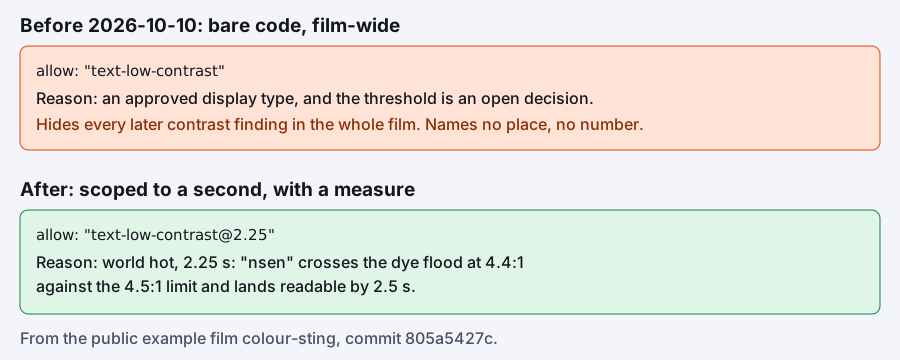
A reason of "approved, and the threshold is an open decision" is not a reason, and our harness now knows it. We audited the lint waivers in 36 film pages and found 13 of them in 8 pages. Three sat in our own gold example and hid a whole code film-wide. Two waived a code that no check had ever emitted. This post covers the rule we wrote after the audit: a waiver must say where and what was measured, or it waives nothing.
The problem: a waiver is a lie you can write in one line
vawe checks a film page with many rules, and the checks advise instead of refusing. When an author breaks a rule on purpose, they declare it in the page, in a small JSON block, with a reason. That is the whole escape hatch, and we like it that way: the reason travels with the page, nowhere else.
The trouble was how little the harness asked of that reason. A waiver named only a code, such as text-low-contrast, and one _why string longer than 12 characters. A bare code covers every finding of that code in the film. A waiver written for one word at 2.25 seconds would also hide a contrast failure at second nine, and nobody could tell from the page.
Three checks (still-limit, the unverified-final gate and anim-traps) each vetted a reason in their own way. Some waivers waived codes that no check emitted at all, so they recorded an intention and did nothing. One code, dead-air, covered four different checks at once: the static window, the sheet tile run, the tail tiles and the world-held limit. A waiver written for one hid all four.
What the audit found
We wrote a read-only audit that asks each check one question: what is the cheapest change that turns it green? (The bigger story is in the post on agents cheating our checks.) For waivers, it counted the following in 36 film pages:
- 13 waiver entries in 8 pages.
- 5 of them were
dead-airover a range, which hid four checks each. - 3 sat in the gold example agents copy:
text-low-contrast,attractoranddisplay-tracking, all bare and film-wide, with reasons that said a person had approved the choice and that a threshold was an open decision. - 2 codes,
glowandoff-colour, that no check onmainemits.
The last point is the one that stuck. Agents copy examples. A gold example with film-wide waivers and a reason that names no place and no number teaches every new film to do the same.
What we built
Length was the only vetting, and an agent can write 60 characters of nothing. So the rule moved from how long a reason is to what it says. The commits are ecb537a and 7ee9506, both on 2026-10-10.
One vetting for every check. entryHasReason in harness/lib/waivers.mjs is the only place that decides whether a reason counts. The three checks that did their own vetting now call it.
One code per check, scoped to seconds. A waiver is code@second or code@a-b for a range. dead-air is retired, and using it prints which four codes to choose from. A scoped waiver does not cover a finding that has no second.
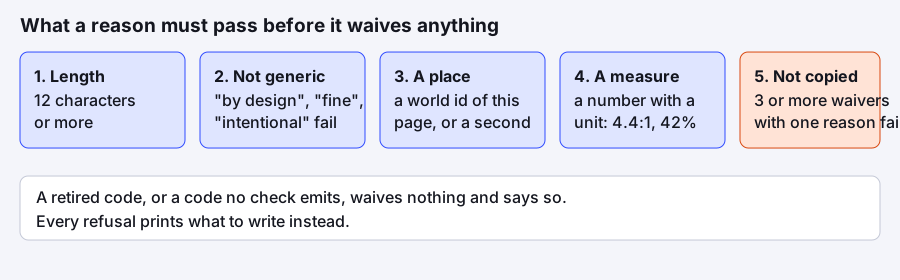
A reason must name where and what was measured. reasonProblem runs five tests: at least 12 characters; not generic ("intentional", "by design", "deliberate", "stylistic", "fine", "ok" and "as intended" are removed and what is left must still have three real words); a place, meaning a world id of this page or a second; a measured value with its unit, such as 4.4:1 or 42%; and no more than two copies of one reason on a page. A refusal prints the missing part, for example "the reason names no measured value: write the number the check printed, with its unit".
The judge sees every waiver. A waiver no longer hides a decision from the fresh-session judge that scores the film.
The result is visible in the public example film colour-sting. Its contrast waiver used to be a bare code. Now it reads:
"text-low-contrast@2.25": "world hot, 2.25 s: 'nsen' crosses the dye flood
mid-move at 4.4:1 against the 4.5:1 limit and lands readable by 2.5 s"
It names the world, the second, the measured ratio and the limit. A reviewer can open the film at 2.25 s and check it in ten seconds. We rewrote the tracking-hud example in the same spirit in cd90a43. One of its reasons says that at 1.95 s a 4k px² readout relocks to its glyph in 0.05 s, while a 1k px² caret types for 0.69 s, so the label jumps to its new lock and does not travel.
The measured result
The audit gives the before-count: 13 waivers in 8 of 36 pages, 3 film-wide in the gold example, 2 dead codes, and one code that covered four checks. We have not run a second audit, so we have no after-count over the same 36 pages. What we do have is a unit test file, tests/lib/waivers.test.mjs, that pins the behaviour: generic reasons are refused however long, a world id that is not on the page does not count as a place, a second alone is a place and not a measure, the same reason on three waivers fails and two passes, and a retired code is refused even with a good reason.
One finding from the audit did not change. No waiver hid the camera drift or the synth bed trick the checks missed. Those passed without a waiver at all. A waiver rule fixes the hatch, not the hole next to it. For that we built the fixtures described in the loophole audit post.
What we would tell you if you build the same thing
Put the waiver in the file it excuses and keep the reason next to it. Scope it: a waiver with no location is a switch for the whole file. Make one function decide whether a reason counts, and have every check call it. Refuse reasons by their content, since length is easy to satisfy. Print a refusal that says what to write, so the agent can fix it in one step. And fix the examples first, because agents copy the first waiver they see.
The quality gates docs list the checks and how waivers work in practice, and the page contract shows the authoring block. For the larger rule behind this, that guards should adapt and not block, see advise on everything, refuse on exactly three things.
In the code
harness/lib/waivers.mjs:reasonProblem,entryHasReason,isWaivedandRETIRED_CODES.tests/lib/waivers.test.mjs: the tests for each refusal.films/examples/colour-sting/page.html: the gold example with scoped waivers.- Commits: ecb537a (one code per check, reasons vetted), 7ee9506 (one vetting for every check), a2646fa (anim-traps), cd90a43 (measured reasons in an example).