Video loudness: our sound sat 9 dB too quiet
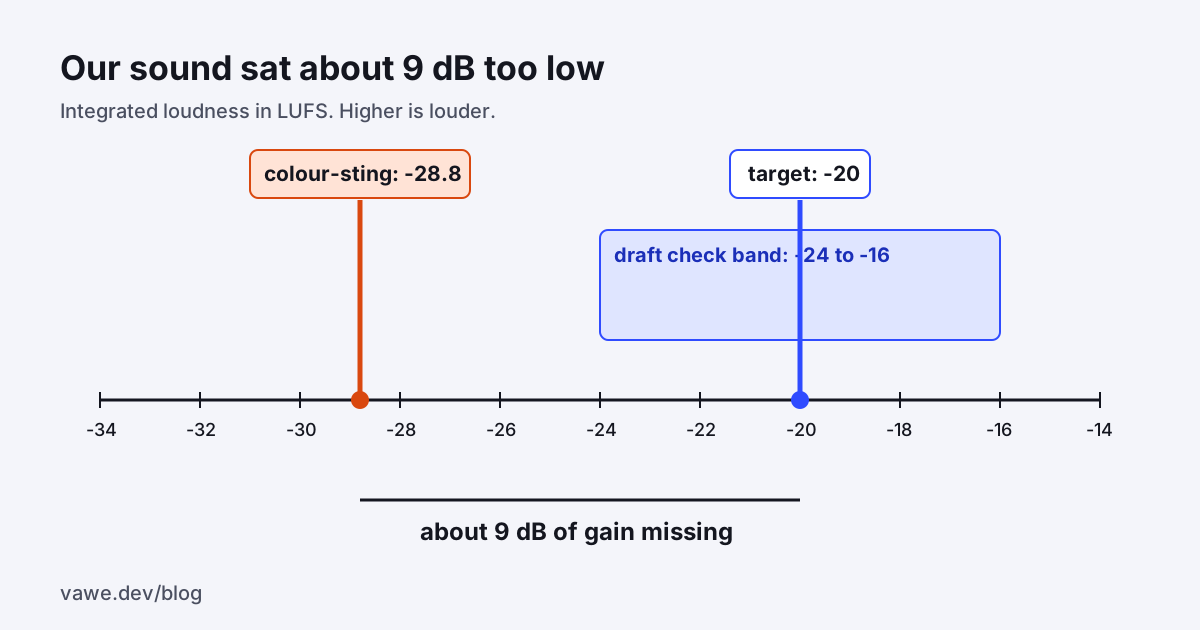
Our sound was 9 dB too quiet, and we only knew because we finally measured it. The example film colour-sting came out at -28.8 LUFS when the level we aim for is near -20. We had not caught it by ear. This post is about video loudness in a pipeline where agents write the sound: what we removed, what we measure, and the one number that turned out to be wrong.
The problem: a mixer with opinions
Early on, vawe had an audio mixer with master targets, branching for "bed" and "cue" films, and a table of transition cues. A film with only short cues and no music bed could end up nearly silent, because the mixer decided how loud the film should be. Another path could push a quiet film up toward a loud target. The author never saw the decision.
There was a second problem. Sound cannot be judged by reading a page, and an agent cannot listen, so nothing told an agent whether the mix was fine.
What we tried
Our first change moved the decision, but kept the shape. Commit d5a9db999 (2026-09-30) made a cue-only film master to -20 LUFS under a -9 dBTP cap: never left near silent, never pushed to -14. That worked for one class of film and kept the branching. Within the same day we replaced it.
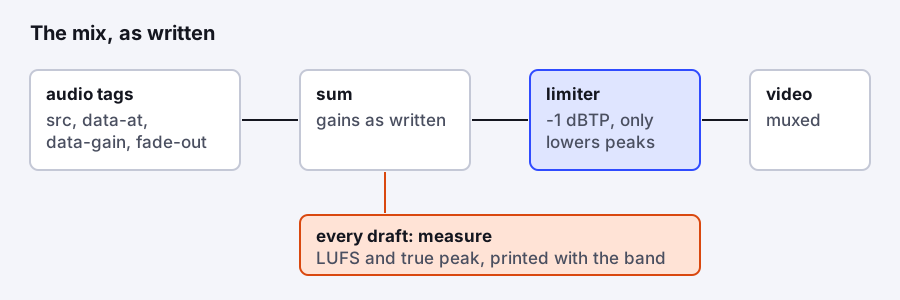
The second change is the one that stayed: mix as written. Commit 57ccc59a3 (2026-09-30) deleted the master target and the bed and cue branching. It was a small diff: 27 insertions and 33 deletions. What remained:
- Audio is
<audio>tags withsrc,data-at,data-gainanddata-fade-out. - The mix is the sum of the tags at the gains the author wrote.
- A limiter at -1 dBTP only lowers peaks. It never raises anything.
- Normalising is opt in, through a
loudnessmeta in LUFS.
The reasoning is the one we use elsewhere in the framework: a tool that changes your result without telling you is a tool you cannot debug. Mixing as written means the number on the tag is the number in the film. For the same reason about guards, see Advise on everything, refuse on exactly three things.
Making quiet the default, then measuring it
We also wanted agents not to start loud. Commit 1d0424ca7 gave each voice a default gain when a tag has none: UI cues at -26 dB, swells at -22 and weight sounds at -18. It also made the audio step warn, never fail, when one cue peaks more than 6 dB above the median, and it names the data-gain to change.
Quiet defaults are a guess until you check the level. So we added the check. vawe dev now measures integrated loudness on every draft and prints it with its band. In commit 8b52cf41c (2026-10-07) the printed line has this shape:
sound: <I> LUFS integrated, <TP> dBTP true peak (band -24 to -16 LUFS, peak at most -3 dBTP)The commit message records colour-sting at -28.8 LUFS: our palette defaults sat 9 dB low.
The measured result
The fix raised the palette gains: tap to -3 dB, tick, air, swoosh-long and sub-thump to -5, swell-soft to -6, shimmer and glass to -7, and the bed to -19. The relations hold: cues stay within 4 dB of each other, and the bed sits 12 dB under the quietest cue. A bed plus one palette cue per beat now lands near -20 LUFS, and tests/media/sound-palette.test.mjs asserts a result between -22 and -18 LUFS.
One more thing moved. The peak limit went from -10 to -3 dBFS, because a transient-heavy palette cannot sit at -20 LUFS and also stay under -10 dBFS at the same time. Our first peak limit was wrong in the same way our first gains were: nobody had tested the two numbers together.
The commit changed 11 files (+45 -26), and the sound check moved into the fast tier, so a draft prints the level every time.
What we would tell you if agents write your sound
- Delete the clever mixer. Auto-targeting hides the cause of a quiet or loud result. We replaced a branching mixer with a sum and a limiter.
- Measure on every draft. Printing LUFS and true peak costs a moment and turns "sounds quiet" into a number with a band.
- Pick a band, not a point. Our draft check warns outside -24 to -16 LUFS around a -20 target.
- Check the peak and the average together. Two limits that cannot both hold are a bug in the defaults, not in the film.
- Limit down, never up. A limiter that only lowers peaks cannot surprise the author.
Later changes kept this shape. A data-trim-end attribute adds a short fade at each cut (5830bedce, 2026-10-10), and the renderer reads the page audio before the capture, so a failed mux keeps the frames (e1b944267). Constant synthesized beds are banned now, which we cover in Banning the synth bed.
The audio rules are in the audio docs. The source is at github.com/Vandit1604/vawe, and the page format the tags live in is in The whole film format fits in one screen. For other ways to put sound on a web-page video, see /remotion-alternatives.
In the code
harness/media/page-audio.mjs: reads the tags, measures integrated loudness and true peak, applies the -1 dBTP limiter.tests/media/sound-palette.test.mjs: a bed plus one cue per beat lands between -22 and -18 LUFS.57ccc59a3(2026-09-30): the mix is as written; the master target and branching are gone.1d0424ca7(2026-09-30): subtle default gains per voice and a warning for a loud cue.8b52cf41c(2026-10-07): palette gains raised, peak limit moved to -3 dBFS, loudness measured on every draft.