How we sped up end-to-end tests 40x by deleting a file format
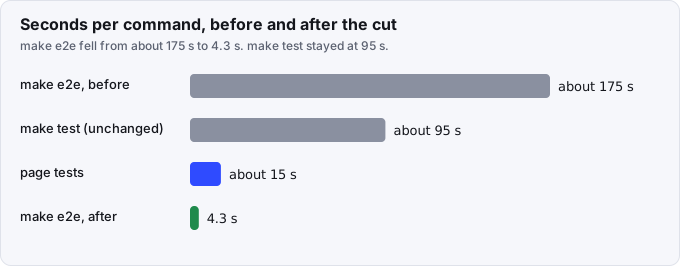
We wanted to speed up end-to-end tests, and the fix was a deletion. make e2e took about 175 seconds. After we removed the file format it mostly tested, the same command took 4.3 seconds.
The problem: a suite that guarded code we were about to remove
By late September, make test took about 95 seconds and make e2e about 175 seconds. Most of that time went to the old JSON scene format: its engine, its Go renderer, its gates. We had already decided to drop all of it after a blind A/B test. The suite was slow in proportion to the amount of code that was about to disappear.
The slowness also made the tests unreliable. On 2026-09-26 more than ten agents were running at once. The laptop's load average sat near 18, and e2e runs failed on timeouts that had nothing to do with the code under test. Our timing tests compared a measured number to a fixed limit, so a busy machine could fail them.
We did not tune the old suite. Tuning code that is about to be deleted is wasted work. Until the deletion commit landed, we ran only the page tests per merge (about 15 seconds) and rebuilt e2e afterwards.
What the new e2e run does
After the JSON format was gone, commit 6d34b376a rewrote harness/dev/e2e.mjs. The new run has two parts.
First it runs the page tests with node --test: determinism, page audio and the motion tests. Second it finds every films/**/page.html and every page in tests/fixtures/pages/, and renders each one as a half-size draft. A small pool runs 2 to 4 renders at once, depending on the core count.
Each render gets one cheap check. The mp4 must exist and be non-empty, and its duration must match the page's <meta name="duration"> within 0.15 seconds. That is the whole assertion. We do not compare pixels here. Pixel-level behavior has its own tests, such as the determinism tests.
The run never stops at the first failure. It collects every result and writes report.json and report.md under quality/runs/e2e/, so one run tells you everything that is broken.
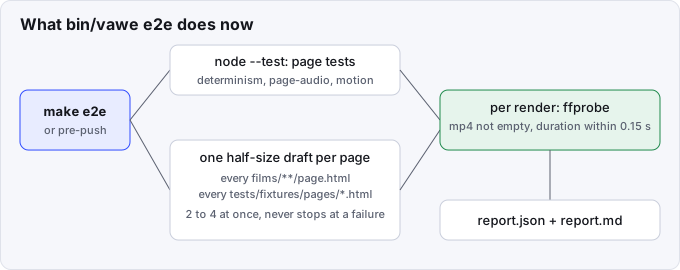
One caveat belongs next to the 4.3 seconds. At that commit the repository had one example film page and two fixture pages, so the run rendered three pages. It grows with the number of films, and we do not claim 4.3 seconds holds at fifty films. The comparison that matters is the shape of the work: a real render of every page, in parallel, against a long run that mostly exercised a dead path.
Timing tests that read the machine first
A fixed limit fails under load. In cb4fe0188 we made the two timing tests measure the machine before they judge it.
The check-budget test stores the seconds each draft check took, plus how long the capture of its fixture took on the stamping run. On a later run it divides this run's capture time by the stamped one. If the machine is 2x slower, each check gets a 2x limit. The stall test does the same: it renders the same page once with no stall, then sets its stall limit to twice that capture time, with a floor of 1.5 seconds.
This keeps the tests honest in both directions. A real regression still fails, because a check that grows without the capture growing is not explained by load.
The rest of the loop
The same week we cut the Makefile down to thin aliases for bin/vawe verbs and rewrote the git hooks (3913b499c, 70 files, +158 and -2,481). Pre-commit runs fast checks. Pre-push runs fast checks plus e2e. Later vawe land (82b68c3c7) wrapped the whole ritual into one verb: fetch, rebase onto origin/main, scan for big files, run the tests, then push with an ssh keep-alive. We wrote about it in cheap waiting.
Our rule is one e2e per merge. Agents do not run it per branch, because ten agents each running a render suite is how the laptop got to a load of 18 in the first place.
Result
| Command | Before | After |
|---|---|---|
make e2e |
about 175 s | 4.3 s |
make test |
about 95 s | about 95 s (unchanged) |
| page tests | n/a | about 15 s |
make test did not get faster. It still runs the full unit suite, and we left it alone. The speedup came from changing what e2e covers. We did no tuning.
What we would tell someone building the same thing
- Ask what share of your suite exercises code you plan to remove. Ours was most of it, and no profiler would have said so.
- Make the end-to-end assertion small and about an artifact: it exists, it is not empty, and it has the right length. A full-size film is a poor place to compare pixels.
- If a test compares a time to a limit, run a control on the same machine first and scale the limit by it.
- Let one run report everything. Stopping at the first failure turns a three-failure problem into three runs.
If you are building a render pipeline around plain web pages, see how the page contract keeps the checks simple, and how this compares with Remotion. The code is at github.com/Vandit1604/vawe.
In the code
harness/dev/e2e.mjs: the page tests plus parallel draft renders.tests/media/check-budget.test.mjsandtests/media/render-stall.test.mjs: timing tests scaled by a control run.- Commit 6d34b376a: the new e2e.
- Commit cb4fe0188: timing tests that scale with the run.
- Commit 3913b499c: thin Makefile and fast hooks.
- Commit 82b68c3c7:
vawe land.