Easingvawe After Effects eases
leave
A decelerating exit: it eases away and slows into its end.
leave reaches 50% of its travel at 40% of the time and 90% at 70%. Its peak speed is 1.95x the average.
Live demo
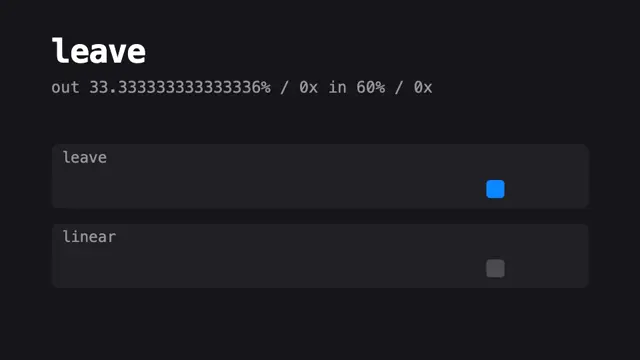
The blue box uses the exact linear() string below, in your browser. The grey box is linear.
Your system asks for reduced motion, so the boxes rest at the end of the move.
Numbers
- 50% of travel
- 40%of the time
- 90% of travel
- 70%of the time
- After 10% of time
- 3.27%of the travel is done
- Peak speed
- 1.95xtimes the average
- Overshoot
- 0%stays inside the end
- Undershoot
- 0%never below the start
- linear() points
- 41at a 0.002 tolerance
- cubic-bezier
- exactbuilt from two handles
Copy the code
animation-timing-function: linear(0, 0.0019, 0.0078, 0.018, 0.0327, 0.052, 0.076, 0.1047, 0.138, 0.1755, 0.2167, 0.2609, 0.3075, 0.3555, 0.4041, 0.4525, 0.5, 0.5461, 0.5902, 0.6322, 0.6718, 0.7088, 0.7432, 0.7751, 0.8044, 0.8312, 0.8557, 0.8779, 0.8978, 0.9157, 0.9316, 0.9456, 0.9577, 0.9682, 0.977, 0.9843, 0.9901, 0.9945, 0.9976, 0.9994, 1);animation-timing-function: cubic-bezier(0.3333, 0, 0.4, 1);This ease is a cubic bezier by construction: the two After Effects handles are its two control points. The site ships the linear() string above because it is what the renderer and EASE.leave use.
el.animate({ translate: ['0 0', '240px 0'] }, { duration: 600, easing: 'linear(0, 0.0019, 0.0078, 0.018, 0.0327, 0.052, 0.076, 0.1047, 0.138, 0.1755, 0.2167, 0.2609, 0.3075, 0.3555, 0.4041, 0.4525, 0.5, 0.5461, 0.5902, 0.6322, 0.6718, 0.7088, 0.7432, 0.7751, 0.8044, 0.8312, 0.8557, 0.8779, 0.8978, 0.9157, 0.9316, 0.9456, 0.9577, 0.9682, 0.977, 0.9843, 0.9901, 0.9945, 0.9976, 0.9994, 1)', fill: 'both' });import { EASE } from '../../core/motion/presets.js';
el.animate(
[{ translate: '0 4vh', opacity: 0 }, { translate: '0 0', opacity: 1 }],
{ duration: 500, easing: EASE.leave, fill: 'both' },
);
// per-frame code (window.seek, vawe.onFrame): easeFn('leave')(u)After Effects handles
One segment between two keys has two handles. In After Effects, open Keyframe Velocity on each key: the outgoing handle belongs to the first key and the incoming handle to the second. Influence is how far along the segment the handle reaches, in per cent of its duration. Speed is the pace at the key as a multiple of the segment's average (0 stops dead, 1 is straight).
| Handle | Name | Influence | Speed | Real handles near it |
|---|---|---|---|---|
| out (first key) | easyEase | 33.333333333333336% | 0x | 33.35% |
| in (second key) | long | 60% | 0x | 6.2% |
Measured on 1,339 real segments (2,678 handles) from Lottie files and 27 from HyperFrames blocks. Near means influence within 10 points and speed within 0.3 (25% above 1x). Both handles together: 9 segments (0.67%), 0.97% of the 616 entrances and 0% of the 57 exits.
import { keys } from '../../core/motion/presets.js';

// out handle on the first key, in handle on the second
keys(el, 'translate', [
  [0, '0 6vh', { out: 'easyEase' }],
  [0.6, '0 0', { in: 'long' }],
]);
When to use it, and when to avoid it
Use it for
- Exits of panels and labels that should settle out of the frame rather than snap away.
- Real exits: in the After Effects data most tuned exits end on this shape.
Avoid it for
- Exits that must clear the frame fast. It is slow at the end. Use launch.
- Entrances. It is built to finish, not to start.
Related eases
Moves that use leave
2 of the library's motion moves set EASE.leave in their snippet.