Grid tile flip
When to use
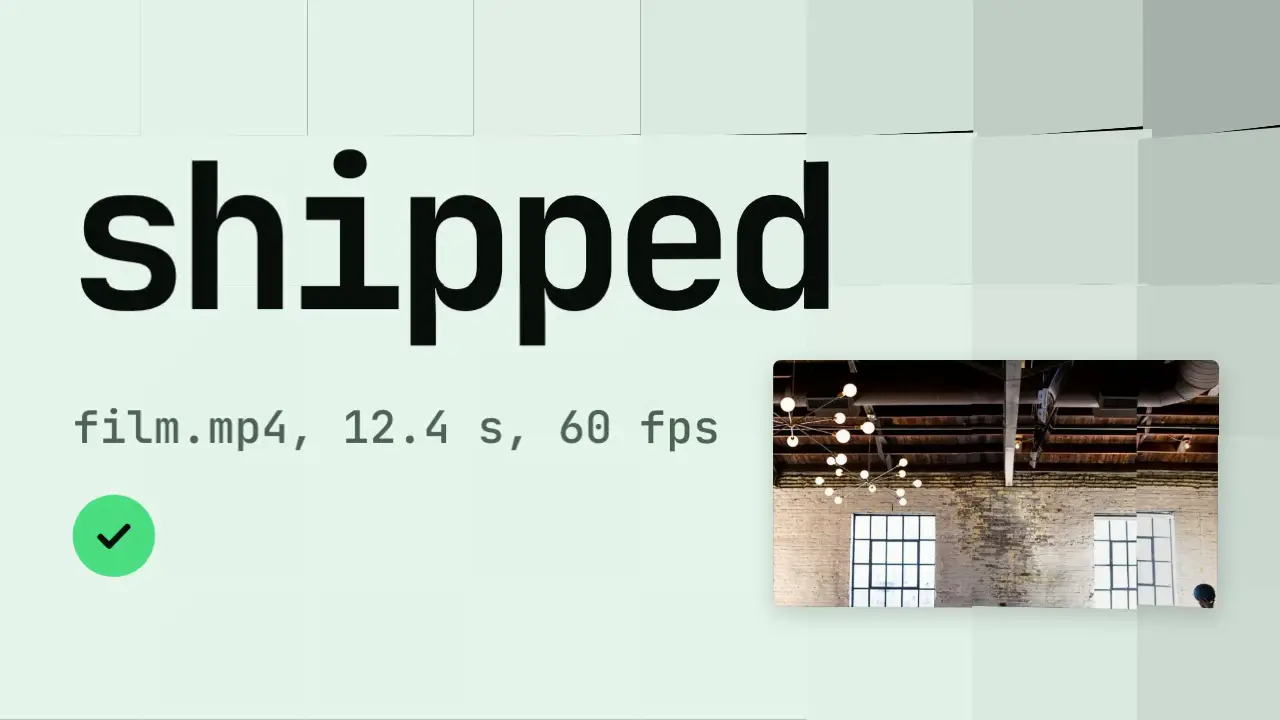
Use when the change between shots should be a physical object turning over: the frame is a wall of tiles, each carrying its slice of shot A on the front and shot B on the back, and a wave of flips crosses the wall from one corner. The detail that sells it is the 3D: one perspective on the whole grid (not one per tile), each tile rises toward the camera as it turns and darkens as it goes edge-on, so the wave has depth and light. Clip: grid-tile-flip.mp4. Demo: demo/grid-tile-flip.html.
The code
import { EASE } from '../../core/motion/presets.js';
const COLS = 8, ROWS = 5, tw = W / COLS, th = H / ROWS;
const dur = 690;
// .grid { perspective: 1400px }  .tile { transform-style: preserve-3d }  .face { backface-visibility: hidden; overflow: hidden }
// .face.back { transform: rotateY(180deg) }: each face holds a full-frame copy of its shot at left -c*tw, top -r*th
for (let r = 0; r < ROWS; r++) for (let c = 0; c < COLS; c++) {
  const delay = 220 + Math.hypot(c, (ROWS - 1 - r) * 1.15) * 58;             // ms: distance from the bottom-left corner
  tile.animate([{ transform: 'translateZ(0) rotateY(0deg)' },
                { transform: 'translateZ(90px) rotateY(90deg)', offset: 0.5 },   // edge-on: highest and darkest
                { transform: 'translateZ(0) rotateY(180deg)' }], { duration: dur, delay, easing: EASE.settle, fill: 'both' });
  for (const f of [front, back]) f.shade.animate([{ opacity: 0 }, { opacity: 0.7, offset: 0.5 }, { opacity: 0 }], { duration: dur, delay, easing: EASE.settle, fill: 'both' });
}
grid.animate([{ scale: 1 }, { scale: 1.045 }], { duration: 1400, easing: EASE.glide, fill: 'both' });   // the wall pushes in the whole time
Easing and timing
The clip runs 1.4 s. The look is terminal.
The clip uses 2 named eases from core/motion/presets.js. Each is a pair of After Effects handles: influence is how far along the segment the handle reaches, and speed is how fast the value moves at the key, as a multiple of the segment's average speed. Motion in the docs explains both.
| Ease | Leaving a key | Arriving at a key |
|---|---|---|
glide | 33% influence, speed 0 | 33% influence, speed 0.1 |
settle | 60% influence, speed 0 | 60% influence, speed 0 |
Notes
Tiles are 1 px larger than their cell: without the overlap, hairline seams show on the settled shot. The ground behind the wall is near black, so the gaps at edge-on read as depth, not as holes. Eight columns and five rows put a tile near the size of a letter, so the wave slices the type and the eye reads the turn; fewer than 6 columns look like doors, more than 12 like a dissolve. EASE.settle starts from rest and settles softly; a linear or ease-in-out flip looks like a card trick. The wave should cross the wall in about half a second; slower than that and shot A is already forgotten.
Looks (ground, type, radius, accent) live in demo/demo.css; this snippet keeps neutral tokens.
Sound
Sound: none; the wave of flips is the seam, and a cue on it is a whoosh on every cut.
Related moves





See all 125 moves. Learn how a page becomes a film in the docs, copy chains of moves from the recipes, or read the motion guide.