Puppeteer deviceScaleFactor: why our half-size draft lied
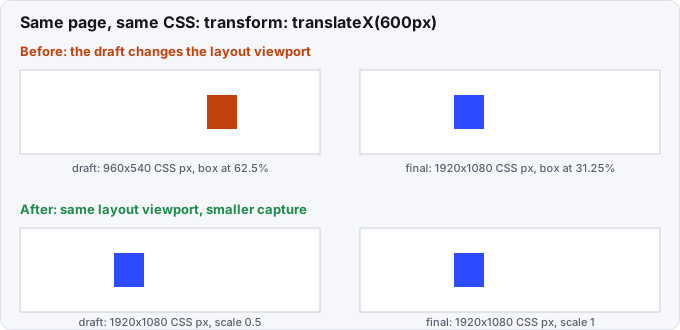
The draft looked fine, the final did not, and the bug was the word "half". Our drafts rendered at half size by shrinking the browser viewport. A box moved with translateX(600px) landed in a different place in the draft than in the final. This post explains how deviceScaleFactor in Puppeteer fixed it, and why we later stopped relying on it for WebGL.
The problem
A vawe film is a web page. A draft is a quick, half-size render that an agent uses to check its edits, and a final is the full 1920x1080 render. For speed, the first version rendered a draft by opening the page in a 960x540 CSS viewport.
That works for percentages and vw units. It breaks for any pixel value. A keyframe that translates by 600 px, or a fixed left: 900px, is 62.5% of the draft width but only 31.25% of the final width. The two renders put things in different places.
The page's own size variables followed the viewport too. A page reads --vw and --vh to size things, so in a draft they described a 960x540 page and in a final a 1920x1080 one.
It cost us real time. An agent fixed a draft that looked right, and the final then showed a block left on screen. The agent had done nothing wrong. The tool had shown it a different layout.
The fix: lay out big, capture small
Commit 1f99365b6 changed what a draft means. The page now always lays out at the aspect's full CSS size, and the browser captures it at a device scale of 0.5 for a draft and 1 for a final. resolveFrame returns the full size plus the scale. The values --vw, --vh, data-aspect and window.vawe.width and height always report the full size, so a page cannot tell it is in a draft.
In Puppeteer this is the deviceScaleFactor option of page.setViewport. A 1920x1080 viewport with a factor of 0.5 gives a 960x540 screenshot. The commit message notes that Chromium honored the factor for screenshots even under --force-device-scale-factor=1, so there was one capture path and no downscale step.
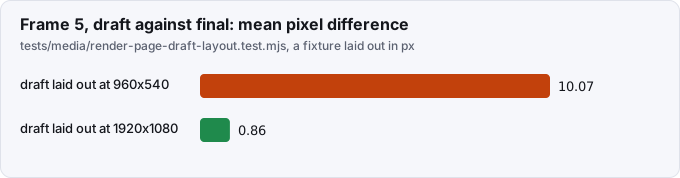
We added a test, tests/media/render-page-draft-layout.test.mjs. It renders a fixture laid out in px as a draft and as a final, then compares frame 5. The mean difference was 0.86 with the fix and 10.07 on the previous code.
The commit also records a timing on the three-star example, a warm draft: capture went from 1.4–1.5 s to 1.3 s, and wall time from 2.7 s to 2.3 s. That is one film and one run, so read it as a sign that the fix did not cost speed.
What failed: a downscale that was not repeatable
The scale factor worked for DOM pages. On a WebGL page it did not. Ten days later (a916e59d6) we found that Chrome's own downscale of a WebGL page gave different pixels from run to run. On the colour-sting example, 117 of 154 captures differed between two renders. A full-size capture of the same page was repeatable.
Because a draft that changes on each run cannot be debugged, we changed the capture again. A draft now captures at device scale 1 and the encode scales the result down with ffmpeg's scale filter and flags=area. The layout fix stays as it was: the page still sees the full size. Only the place where the pixels shrink moved, from the browser to ffmpeg.
We added tests/media/render-draft-halfsize-determinism.test.mjs. It renders a one-and-a-half-second window of colour-sting twice and compares the per-frame hashes. The output must be 960x540, 45 frames, and identical across runs.
Capturing at full size costs more than capturing at half. We accepted that for correctness, and gave the time back elsewhere: JPEG capture and slices sized to the work. That story is in fast drafts.
Result
- Frame 5 mean diff between draft and final: 0.86, down from 10.07.
- WebGL captures that differed between two draft renders: 117 of 154 before the full-size capture, repeatable after.
three-starwarm draft: 2.7 s down to 2.3 s from the first change.
What we would tell someone building the same thing
- Never change the layout viewport to make a preview smaller. Change the capture scale. Any pixel value in the page depends on the viewport.
- Expose the full size to the page (
--vw,--vh) in every mode, so authors have one number to design against. - Test the draft against the final with one frame and one fixture laid out in px. A single number caught this bug.
- Check repeatability separately from correctness. A scale that is right but different each run is still a bug, and WebGL found it for us.
The same principle sits behind the clock: the page must not know it is in a draft, just as it must not know the wall time. See time is the seek, never the clock and the determinism docs. For a comparison with other tools, see HyperFrames alternatives. Source: github.com/Vandit1604/vawe.
In the code
harness/media/render-page.mjs:resolveFrame, and the draft encode withflags=area.tests/media/render-page-draft-layout.test.mjsandtests/media/render-draft-halfsize-determinism.test.mjs.- Commit 1f99365b6: lay out at full CSS size, capture at device scale 0.5.
- Commit a916e59d6: capture at scale 1 and scale in ffmpeg.
- Commit e0da1a9b7: JPEG capture and slices sized to the work.