CSS easing curves need names: 44 pages of easing data
Our moves and the agents that wrote them typed cubic-bezier numbers by hand, so exits, landings and short pops felt inconsistent. The fix was names. We gave nine curves names, put the names in one file, and published every curve we use, plus 35 more, as 44 easing pages with the numbers behind them. This post covers the CSS easing curves we ended up with, the two that went wrong at first, and the one number we could not measure.
The problem: easing written as raw numbers
A vawe film is one HTML page that animates with CSS keyframes and Web Animations. Easing is the part of an animation that an agent or a person writes without thinking: a four-number cubic-bezier or a CSS keyword. Across the moves library, those numbers had no shared meaning. Short pops landed too hard, exits ran as long as their entrances, and two moves that should have felt related used unrelated curves.
The common fix is a table of names, which every motion system has. Ours had one extra requirement. Agents write these pages, and an agent that sees EASE.launch makes a better choice than one that sees four floats. A name carries a purpose.
What we tried first, and where it broke
We started with six names built from After Effects keyframe handles: an influence (how far along the time axis the handle reaches) and a speed (how steep the curve is at the key). land is a fast start with a long soft stop, leave and launch are exits, settle and swap are two-sided eases, glide is a drift.
Two of them failed on real clips.
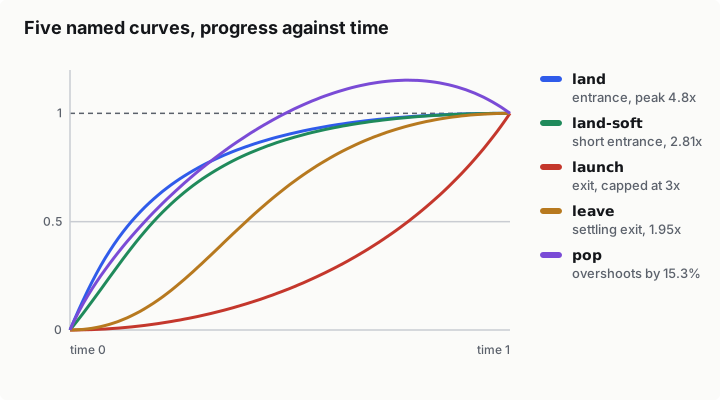
land peaks at 4.8 times average speed. On a move shorter than 0.4 s that reads as a jump, and the README note in the fix commit says so. We added landSoft, which keeps the long soft stop but drops the peak speed to 2.81 times average (a5fd39d88), then lengthened the short pops and exits the energy measure had flagged (766c2a809).
launch had the opposite problem. An exit that accelerates into a cut is right, but our first version ended at 4.8 times average speed at the cut, and the same README note says it read as a vanish. We capped launch at 3 times at the cut.
The CSS easing curves we built: names, a ramp, 44 pages
The vocabulary is nine entries in core/motion/presets.js: land, landSoft, settle, swap, glide, carry, leave, launch and pop. Each is two handles. Each converts to a CSS linear() string, and the pages show the nearest cubic-bezier with its error. pop is the one that overshoots. It passes its mark by 15.3 percent and settles back, which is the shape a button press or a notification wants.
| Name | Job | Peak speed |
|---|---|---|
land | entrance, fast start, long stop | 4.8x |
landSoft | entrance under 0.4 s | 2.81x |
launch | exit that accelerates, capped at the cut | 3x |
leave | exit that settles | 1.95x |
pop | arrival that overshoots by 15.3% | 4.79x |
The same pass added ramp(), a speed ramp across a cut. The outgoing element accelerates into the cut and the incoming one leaves it at the same speed and slows down, so the velocity matches on both sides (8f117991b). Matching velocity across the cut is the part people get wrong by eye. See the speed-ramp move.
Then we generated the pages. A script reads the motion library and writes one JSON file with the curve, its velocity, the linear() string, a cubic-bezier fit and the After Effects handle values for every ease. The site renders 44 pages from it: the nine vawe curves, 30 classic ones (ten families, in, out and in-out) and the 5 CSS keywords including linear (88f2f435a). Nothing on a page is typed by hand except the words. Each vawe page carries a 2 s clip of the curve moving a square next to a linear one.
Where the numbers came from
We did not pick the handle values by taste. We pulled 1,339 animation segments from open-source Lottie projects (from the lottie-android, lottie-ios and lottie-web repositories) and 27 segments from HyperFrames carousels, and measured them. In that sample 65.05 percent of segments used the default handles, 468 were tuned, 616 were entrances and 57 were exits. No exit in the sample ran faster than 1.5 times at its end. Our rule that exits accelerate is a deliberate step away from that, which is why launch is capped at 3x.
The same data gave the exit rule. Exits are shorter than entrances and accelerate. The house range is 0.35 to 0.6 of the entrance duration, and leave() in the presets uses 0.6. That rule is written once in taste/rules/exits-shorter.md, and a check flags an exit as long as its entrance.
What the names measured, and what they did not
Fact: the library has 44 easing pages, every number computed from core/motion. Fact: across 22 reference films, the median share of arrivals that overshoot is 30.5 percent (p10 21.1, p90 40.9), and the overshoot-share check is built on that range. The measured bar is the subject of a separate post.
What we do not have is a before and after. We did not render the same film with ad hoc curves and then with named ones and compare scores. The commit history shows the clips were re-rendered with the new names, and the short-move fixes came from a measurement (the energy measure flagged them), but there is no number for "films got better by X". We would rather say that than invent one.
What we would tell someone building the same thing
Start with the jobs, not the curves. We named land, leave and launch for what the element is doing, and the curve falls out of the job. Then test each name on the shortest move that will use it, because that is where a curve with a high peak speed fails first.
Cap what the cut can see. A curve that ends fast reads as a vanish at a cut, however nice it looks in isolation. And publish the numbers. Writing the pages made us compute peak speed, the time to 50 and 90 percent, and a bezier fit for every curve, so each name now has numbers a reviewer can check.
Last, keep one owner. The names live in one file, the pages are generated from it, and a rule file cites it. See one owner per rule for how we cleaned up the duplicates that came before.
In the code
core/motion/presets.js: theEASEvocabulary,leave()andramp()scripts/site/easing.mjs: builds the data for the easing pages from the motion librarysite/app/easing/: the 44 pages, plus the indexa5fd39d88:EASE.landSoft, andlaunchcapped at 3x at the cut8f117991b:ramp()with matched velocity on both sides88f2f435a: the 44 easing pages
The repo is Vandit1604/vawe.