Video reference comparison: our agent never did it
An agent made a film in the style of a reference clip. Our judge scored it 62, then 61, then 62. The person who owned the reference looked at it and said the concept was right and the look was wrong. Both were true, because the judge had never seen the reference. This is a story about video reference comparison, and about how an agent can pass every check in the loop by measuring its film against its own plan.
The problem
We read the trace of one session: an 8 s film in the style of a reference, built by a weaker model. The reference entered the work at stage 2. The agent read 5 key frames and 2 of 16 strips, and it read the top 60 lines of the reference's spec file. After that, it dropped out of every tool call. From that point on, 0 of 83 vawe calls carried the reference id or a --ref flag.
So every later check compared the film with something the agent wrote itself. The acceptance rows measured the agent's own word and shot tables. The range checks used a generic range from 17 other films. The judge printed "side-by-side comparison skipped: the film type is unknown", because it chose its comparison films from the film type, and a film that names its own reference never got compared with it.
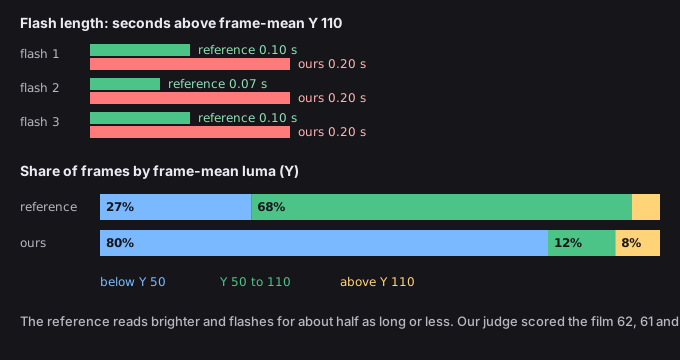
Here is where the gap showed up, measured on the final film against the reference.
- Flashes. The reference has 3 flashes, each a run of frame-mean luma above Y 110, lasting 0.10, 0.07 and 0.10 s. Ours were 0.20 s each, twice as long or more.
- Brightness. In the reference, 27% of frames sit below Y 50, 68% between Y 50 and 110, and 5% above 110. In ours the split was 80%, 12% and 8%. Ours was a dark and sparse film. The reference was not.
- Glow and screen. Our glow was a
text-shadow. The reference showed halation glow, a pixel-grid screen and a lens tilt.
Each of these is a number a tool could have printed. None of them was.
What we tried, and where it failed
Our first instinct was to blame the agent. It did read the reference. It skipped four of five design rungs with the reason "the reference defines it", and the skipped rungs were exactly where the faults were: colour (the flashes), depth (no real lens) and type (the glow). The check that accepted the skips took any non-empty reason.
The critique step failed in a quieter way. A subagent critic read three sheets, and one of them sampled 8 frames at 1 frame per second for a 16-shot film. A 0.2 s flash does not show up at 1 fps. The critic wrote that it could not find the flash frames, and the flashes were the first thing the owner of the reference had seen.
What we built
We made the reference the default, and we gave the agent instruments to read the page the way we read the reference.
Default to the named reference. Commit 5b98da554 made critique, compare and judge default to the reference the brief names, added a reference card to refs frames, and made the dev next line name the next unmet step. 8 files changed, 214 lines added. AGENTS.md now says it in one line: the brief names the reference, and critique, compare and judge default to it.
One instrument for both sides. Commit 99916c823 renders the page and reads it with the same reference-spec reader as the reference, so the DOM only names the elements. A mismatch between two measurers cannot create a delta.
Measure what the eye saw. Commit bbe1d2714 added vawe look (flashes, clipped share, bloom, chromatic offset, screen texture, glow colour, with advice) and vawe zoom (a nearest-neighbour crop of one region, beside the same region of a second film). 8 files, 824 lines. look, zoom and see take --vs <ref> and print deltas. Commit 4411a2b96 made flash count deltas say how many.
Blur that follows travel. The same trace review fed our render. Commit f5789a68a measures the edge travel of a turn and an inset clip. In one test film, a clip edge moved 181 px a frame where the box moved 124 px, and the turn now gets 16 subframes, not 8. We wrote about it in Motion blur from real travel. The exposure flash move and the lens move are the moves closest to this problem.
A tool for the whole film. cbc71f813 added vawe see, which reads a film completely and takes --vs. It is 22 files and 1,653 lines added. See Teaching an agent to watch a film.
The result
The numbers at the top of this post are the finding, not the fix. We have no score after the change: we did not rerun that film, and we will not invent one.
What the next review showed was behaviour. In later sessions, agents used look --vs and zoom --vs 10 times and see --vs 3 times, and the judge's default reference worked. Before, the reference was never reused after stage 2. It is a count of use, not a measure of quality.
What we would tell someone building the same thing
Give the reference the same instrument as the page. If you measure one with a person's eye and the other with a script, the delta is partly the difference between the two.
Default a flag, do not document it. We had a --ref flag. Agents skipped it. Making the brief name the reference, and every check read the brief, removed the choice.
Do not sample at a rate lower than the thing you look for. 1 fps cannot see a 0.2 s flash.
Distrust a score that compares a film with a plan. Our acceptance table counted green rows (6 or 7 of 15 every time) that measured the agent's own tables. For the next step on that problem, see The measured brief and The quality bar is a measured set of real films.
The framework is open source at github.com/Vandit1604/vawe.