Reading AI agent traces: 74% of a session was waiting
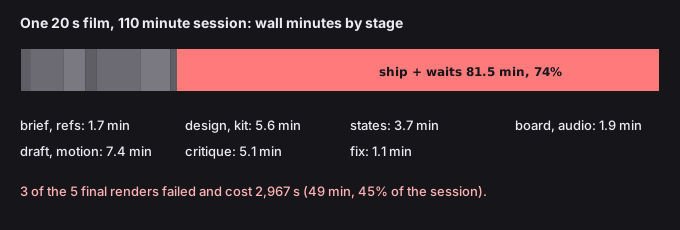
We spent weeks tuning checks before we looked at where an agent actually spent its day. When we read the traces of AI agents building films with vawe, one number stood out. In a 110-minute session, 81.5 minutes were final renders and the polls that waited for them. That is 74% of the wall time, and the drafting, which we had tuned for weeks, was 7%.
This post is about the three trace reviews we ran on 2026-10-10 and 2026-10-11, what they found, and what we changed.
The problem: we had never measured the agent's time
Our checks, our judge and our taste rules all measure the film. None of them measured the agent. We had out/<film>.runs.jsonl, which logs a few events per film, and we had the transcripts of the agent sessions. We had not put the two together.
So we did a read-only review: no render, no test, no edit. We rebuilt a timeline for each session with a small script that pairs every tool call with its result. The method has limits. Parallel calls overlap, so the tool-time columns count them twice. Cost fields in resumed sessions may be cumulative. We say so where it matters.
What the traces showed
An 8 s film took a 73-minute span, 56 minutes of it active. The agent made 162 tool calls: 106 Bash, 53 Read, 2 Write and 1 agent call. Of those, 62 sat in the draft and motion-pass loop. It started 3 final renders. They took 390, 400 and 421 s, and the agent waited for them in the foreground with 16 poll calls of 100 s each.
A 20 s film took 110 minutes and 170 tool calls. Here is the split by stage.
Ship and waits took 68 calls and 81.5 minutes. Of 130 Bash calls, 52 were ship --status --wait polls. Those polls account for 17.6M of 40.7M cache-read tokens in that session, 43%. The agent often sent three or four polls in one message, and they ran one after the other, each up to 100 s.
The session record also showed API time of 1,235 s out of 6,630 s (19%) and tool time of 5,562 s (84%). The two overlap, but most of the session was tool time, not model time.
3 of the 5 finals failed.
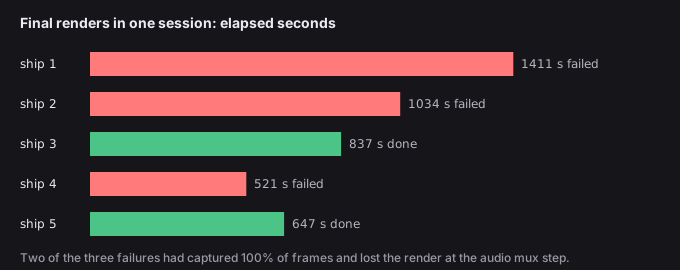
The failed ones cost 2,967 s, which is 49 minutes or 45% of the session. Two of them were captured to 100% (the log shows capturing 19198/19200) and then lost at the audio mux step with a "detached Frame" error. The run log recorded failedAt: 0, so the next ship started from the beginning and did a full second capture. The third failure lost a slice after four tries because another process closed the shared browser.
The agent could not see its own failures. Of 140 vawe calls in one review, 134 were piped into tail, head or grep. A pipe hides the exit code. The tool flag showed 2 failures per session, and the real count was higher.
The second and third rounds added more. In a later review of eight sessions, draft slot waits totalled 1,156 s across five films. In one, a draft spent 357 s of its 427 s waiting for a render slot behind a final. In another log, vawe sound failed 8 of 19 calls on cues shorter than one second, with a message that hid the real cause: the reader needed one second of samples. Twelve status calls cost 3,922 s for 4 finals in one session. A final render takes about 16 minutes, and agents shipped one on their own whenever they finished.
What we changed
Each finding became a commit.
- A mux failure no longer throws the capture away. e1b944267 reads the page audio before the capture, keeps the frames and records the real stage when the mux fails.
- A resume finds its frames. 7d840bb3e keys the kept-frames folder on file bytes, not file times, because a rebase or an edit in another session changed the key.
- Waiting is cheap.
shipruns in the background (a5d092c22).ship --status --waitblocks up to 9 minutes with a progress line each minute (e3e504636).vawe waitblocks on any render of a film (f0ab4f483). We cover the details in Making the wait cheap. - A final never takes the last free render slot, so a draft does not queue behind finals (05aa73d9c).
- A final needs approval of the current page. 2ac1331ab is 13 files, 228 lines added and 12 removed. See advise on everything, refuse on three things.
- Short cues work. 6ec0d5adc lets
vawe soundread a cue under one second. - Two natural calls stop failing. 3f5749500 defines
vawe.onFramebefore any page script. d81896d45 letsstrip --cutsread the declared worlds of a canvas film. - Every verb now ends with an
okorFAILEDline, so a pipe cannot hide the result. - The review script got a fix too. 75fb24d56 counts a hook block only from the hook's own refusal line.
The measured result
We did not rerun the reviews after the fixes. We have the before numbers and the commits, and no clean after. Two later data points help. In the later sessions we read, agents no longer stacked parallel polls, and one agent used the new vawe sound verb 21 times once it existed. We do not claim a time saving.
What we would tell someone building the same thing
Measure the agent before the film. We tuned film checks for weeks and never asked how much of a session was the agent waiting.
Read the transcript next to the run log. The run log had 21 lines for 162 tool calls in one session, so it was blind to most of what happened. We came to see why in Run logs: every verb writes one line.
Make failure loud. A piped command hides the exit code, a failed final that reports 0% sends the next run back to the start, and a message that says "no output" hides the real cause.
Do not ask an agent how long a step took. Read the clock in the trace.
For the next level of this, see Building the harness for the weaker model. The framework is open source at github.com/Vandit1604/vawe, and the determinism page explains why a render can be resumed at all.