Dot grid wave
When to use
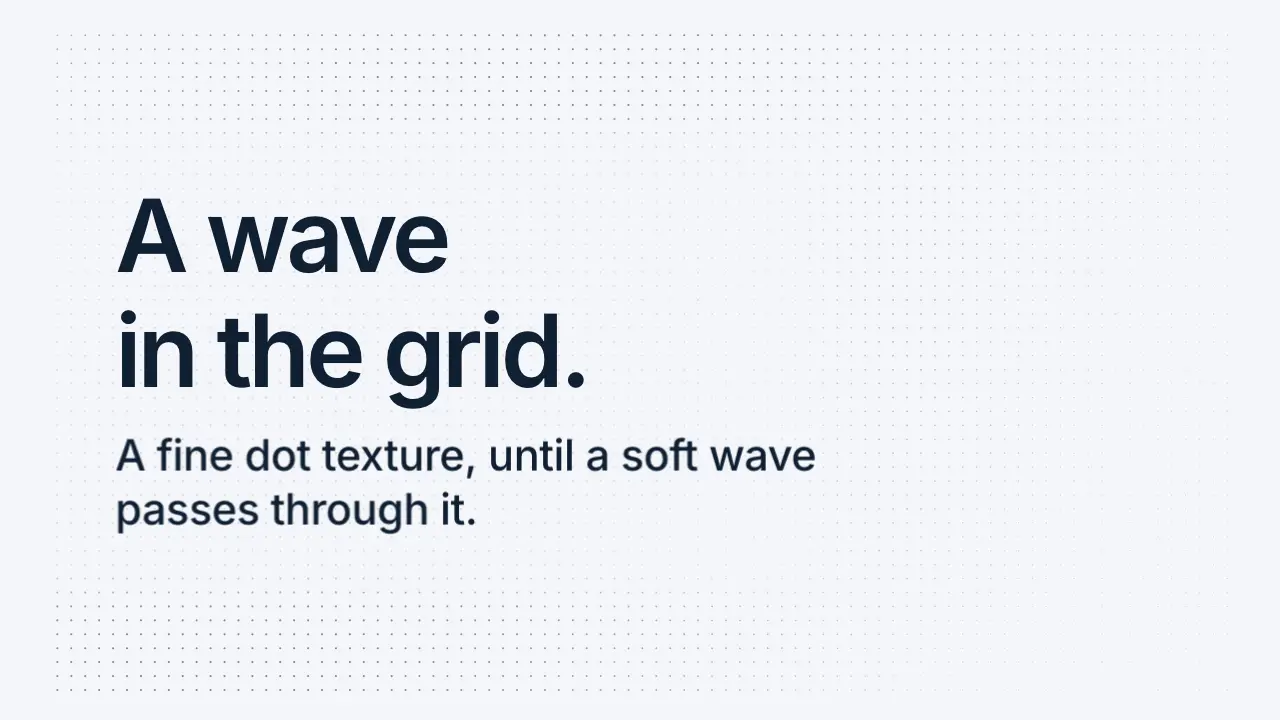
Use when a clean product or data frame needs a ground that reads as a fine texture and shows a wave only when it passes: a field of 2 to 3 px dots on a 22 px pitch (at 1080 p), and one soft wave of scale and opacity that travels across it. It is SVG with the look's ink, no shader. The dots behind the copy fade to a quarter. Clip: dot-grid-wave.mp4. Demo: demo/dot-grid-wave.html.
The code
import '../../core/engine/page-api.js';
const PITCH = 0.021, BASE = 0.0011, SPEED = 1.7;      // pitch (22 px at 1080) and radius (1.2 px) as shares of the frame height
const W = innerWidth, H = innerHeight;
const svg = document.getElementById('grid');          // <svg class="grid">, position: absolute; inset: 0
svg.setAttribute('viewBox', `0 0 ${W} ${H}`);
svg.style.fill = getComputedStyle(document.documentElement).getPropertyValue('--ink');
const smooth = (a, b, v) => { const t = Math.min(1, Math.max(0, (v - a) / (b - a))); return t * t * (3 - 2 * t); };
const dots = [];
for (let y = PITCH * H / 2; y < H; y += PITCH * H) {
  for (let x = PITCH * H / 2; x < W; x += PITCH * H) {
    const c = document.createElementNS('http://www.w3.org/2000/svg', 'circle');
    c.setAttribute('cx', x.toFixed(1)); c.setAttribute('cy', y.toFixed(1));
    svg.append(c);
    const zone = (1 - smooth(0.60 * W, 0.74 * W, x)) * (1 - smooth(0.30 * H, 0.40 * H, Math.abs(y - 0.5 * H)));   // the copy box
    dots.push({ c, nx: x / H, ny: y / H, keep: 1 - 0.75 * zone });               // a quarter of the opacity behind the copy
  }
}
vawe.onFrame((t) => {
  for (const d of dots) {
    const w = (0.5 + 0.5 * Math.sin(2.4 * (d.nx * 0.9 + d.ny * 0.45) - t * SPEED));   // a long plane wave, a pure function of t
    d.c.setAttribute('r', (BASE * H * (1 + 0.5 * w)).toFixed(2));
    d.c.setAttribute('opacity', (d.keep * (0.10 + 0.42 * w)).toFixed(3));
  }
});
Easing and timing
The clip runs 4 s. The look is daylight.
The clip uses one named ease from core/motion/presets.js. Each is a pair of After Effects handles: influence is how far along the segment the handle reaches, and speed is how fast the value moves at the key, as a multiple of the segment's average speed. Motion in the docs explains both.
| Ease | Leaving a key | Arriving at a key |
|---|---|---|
land | 12% influence, speed 4.8 | 75% influence, speed 0 |
Notes
Owner feedback on the first version ("dot backgrounds I don't like, too big dots") rebuilt this move. The first version had 7 px dots on a 37 px pitch in the accent colour. This one has 2.4 to 3.6 px dots (0.22 to 0.33 percent of the frame height) on a 22 px pitch at 1080, in the look's ink at 10 percent opacity at rest and 52 at the crest. Taken from zeke/swiss-design: opacity, not a second hue, makes the hierarchy; from mengto/container-lines: structure drawn thin and at low opacity, behind the content. demo/demo.css tokens won where they differed.
Measured on the 4 s demo clip at 640 x 360 on the daylight look: the mean luma change is 0.18 per frame at 60 fps and about 0 once the copy has settled, below the 0.5 to 3.0 band. That is the cost of a fine texture: the dots cover under 2 percent of the frame, so the wave shows as a slow tide of opacity, which a viewer sees on a full-size frame and the luma number does not catch. The worst contrast of navy ink against the darkest pixel behind the text box is 9.5:1. Do not animate cx or cy: a grid whose dots move reads as a swarm, not a wave.
Looks (ground, type, radius, accent) live in demo/demo.css; this snippet keeps neutral tokens.
Sound
Sound: none; a held ground is quiet.
Related moves

See all 125 moves. Learn how a page becomes a film in the docs, copy chains of moves from the recipes, or read the motion guide.