Grain field
When to use
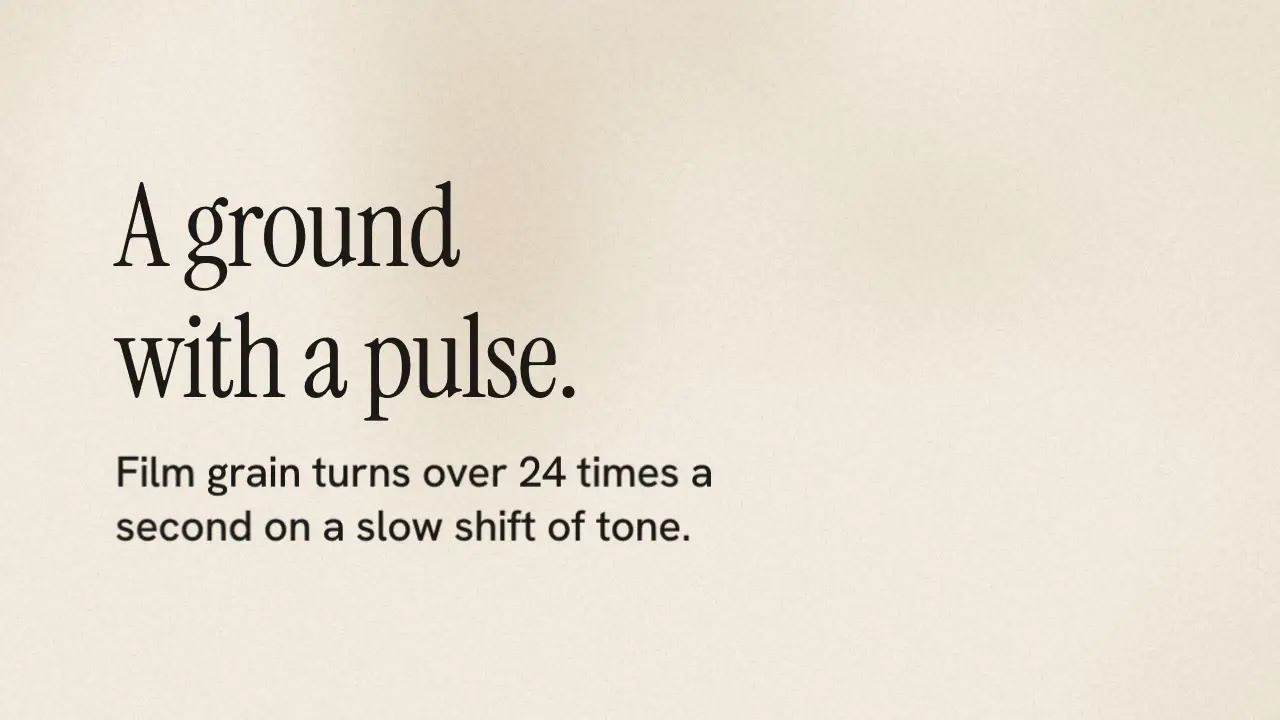
Use when a quiet, printed or filmic frame must breathe: a slow tonal ground, two soft patches of tone that wander, and fine film grain that turns over 24 times a second on top. The type stays clean. The grain is a hash of the pixel cell and the frame number, taken from the seek time, so every render draws the same grain. Clip: grain-field.mp4. Demo: demo/grain-field.html.
The code
import '../../core/engine/page-api.js';
import { shaderField } from '../../core/surfaces/shader-field.js';
const css = getComputedStyle(document.documentElement);
const rgb = (name) => { const h = css.getPropertyValue(name).trim(); return [1, 3, 5].map((i) => parseInt(h.slice(i, i + 2), 16) / 255); };
const frag = `
uniform vec3 u_ground, u_raised, u_accent;
float hash(vec2 p) { return fract(sin(dot(p, vec2(127.1, 311.7)) + u_seed * 17.0) * 43758.5453); }
float vnoise(vec2 p) {
  vec2 i = floor(p), f = fract(p); f = f * f * (3.0 - 2.0 * f);
  return mix(mix(hash(i), hash(i + vec2(1, 0)), f.x), mix(hash(i + vec2(0, 1)), hash(i + vec2(1, 1)), f.x), f.y);
}
void main() {
  vec2 p = gl_FragCoord.xy / u_res.y;
  float tone = 0.6 * vnoise(p * 1.6 + vec2(u_time * 0.45, -u_time * 0.3))      // two layers of slow tone
             + 0.4 * vnoise(p * 3.0 - vec2(u_time * 0.25, u_time * 0.55));
  vec3 col = mix(u_ground, u_raised, smoothstep(0.30, 0.70, tone));
  col = mix(col, u_accent, 0.07 * smoothstep(0.55, 0.85, tone));                // a trace of the accent in the warm patches
  float frame = floor(u_time * 24.0 + 0.001);                                    // grain turns over at 24 fps, from the seek
  vec2 cell = floor(gl_FragCoord.xy / 2.0) + vec2(frame * 17.31, frame * 5.77);  // a 2 px grain
  float grain = hash(cell) + hash(cell + 41.7) - 1.0;                            // two hashes: a triangular spread, no hard speckle
  gl_FragColor = vec4(col + grain * 0.035, 1.0);
}`;
const field = shaderField(frag, { seed: 5, uniforms: { u_ground: rgb('--ground'), u_raised: rgb('--raised'), u_accent: rgb('--accent') } });
vawe.onFrame((t) => field.draw(t));                                              // never Math.random: the virtual clock owns it
Easing and timing
The clip runs 4 s. The look is paper.
The clip uses one named ease from core/motion/presets.js. Each is a pair of After Effects handles: influence is how far along the segment the handle reaches, and speed is how fast the value moves at the key, as a multiple of the segment's average speed. Motion in the docs explains both.
| Ease | Leaving a key | Arriving at a key |
|---|---|---|
land | 12% influence, speed 4.8 | 75% influence, speed 0 |
Notes
Measured on the 4 s demo clip at 640 x 360 on the paper look: the mean luma change is 0.95 per frame at 60 fps, 0.8 once the copy has settled. The grain gives most of it, so the number moves with the grain amplitude (0.035 here, about 9 levels of 255) and the grain rate: grain at 60 fps doubles the change and starts to shimmer. A 2 px cell survives the 640 px downscale and the encode; 1 px cells vanish in it. The worst contrast of the ink against the lightest and darkest pixel behind the text box is 10.2:1 over 12 frames. Keep the two tones within a few percent of each other: the ground moves in tone, never in shape, so it does not pull the eye from the line. Never seed the grain with Math.random: the page clock replaces it, and a grain built from earlier frames breaks the seek.
Looks (ground, type, radius, accent) live in demo/demo.css; this snippet keeps neutral tokens.
Sound
Sound: none; a held ground is quiet.
Related moves

See all 125 moves. Learn how a page becomes a film in the docs, copy chains of moves from the recipes, or read the motion guide.