Underline road
When to use
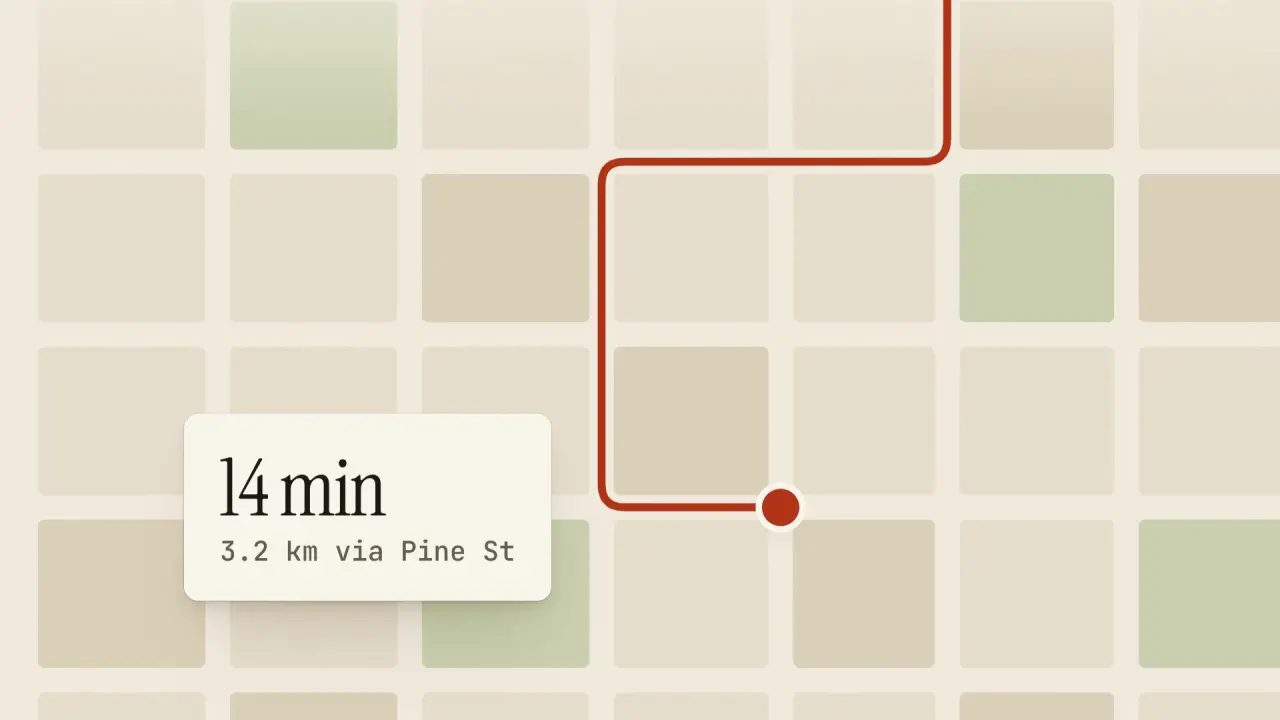
Use when a headline is about a way to somewhere and the next scene is a map: the underline under the key word extends past the line, bends down, and becomes the route on a simple map. The underline is the shared element, one stroke from the first frame to the last, and the camera follows its head down the page into the map. There is no cut and no crossfade. The detail that sells it is the camera: it trails the head at the same speed while the line runs down, so the viewer never sees a seam, and it stops when the map ends. Clip: underline-road.mp4. Demo: demo/underline-road.html.
The code
import '../../core/engine/page-api.js';
import { easeFn } from '../../core/motion/presets.js';
const land = easeFn('land'), swap = easeFn('swap');
const T_UL = 0.35, D_UL = 0.4, T_GO = 1.05, D_GO = 1.8, k = 0.09 * H;
const sp = (x) => k * Math.log(1 + Math.exp(x / k));                 // a soft max(x, 0): the camera starts and stops without a kink
const stops = (x0, y0) => [[x0, y0], [XS[5], y0], [XS[5], YS[2]], [XS[3], YS[2]], [XS[3], DEST.y], [DEST.x, DEST.y]];   // street centres
vawe.onFrame((t) => {
  world.style.translate = '0 0';                                     // measure the word before the camera moves
  const r = word.getBoundingClientRect();
  route.setAttribute('d', rounded(stops(r.left, r.bottom - 0.1 * r.height), 3.2 * u));   // corners are quadratic curves, radius 3.2 u
  const total = route.getTotalLength(), under = r.width, go = clamp((t - T_GO) / D_GO);
  const s = t < T_GO ? under * land(clamp((t - T_UL) / D_UL)) : under + (total - under) * (0.5 * go + 0.5 * swap(go));
  route.style.strokeDasharray = `${total} ${total}`; route.style.strokeDashoffset = total - s;
  const head = route.getPointAtLength(Math.min(s, total));
  const x = head.y - 0.62 * H;
  world.style.translate = `0 ${-(sp(x) - sp(x - 1.2 * H))}px`;       // follow the head from 62 percent of the frame, stop at 1.2 frames
});
Easing and timing
The clip runs 3.9 s. The look is paper.
The clip uses 3 named eases from core/motion/presets.js. Each is a pair of After Effects handles: influence is how far along the segment the handle reaches, and speed is how fast the value moves at the key, as a multiple of the segment's average speed. Motion in the docs explains both.
| Ease | Leaving a key | Arriving at a key |
|---|---|---|
land | 12% influence, speed 4.8 | 75% influence, speed 0 |
pop | 12% influence, speed 4.8 | 35% influence, speed -1.5 |
swap | 75% influence, speed 0 | 75% influence, speed 0 |
Notes
- One world, 2.5 frames tall: scene A at the top, the map below, one stroke over both. Z-order: map under, headline copy, route, pin, ETA card. The map has no top edge: a static gradient mask keeps it clear for 105 vh and fades it in over the next 28 vh, and the map layer is 2.5 frames tall so no row is cut when the camera stops. A few blocks are parks.
- The route follows street centres, and the streets are gaps of 3.4 u between blocks, so the line runs inside a road. The stroke is 1.1 u for the whole length: an underline and a route are the same line.
- The head runs half linear, half
EASE.swap: no stop at the bend, a soft arrival at the pin. The camera velocity equals the head's down the vertical run, which keeps the head at 62 percent of the frame height. - Cause before effect: the underline draws under the word and holds 0.3 s so the word is read, then the line runs. The pin pops on
EASE.popwhen the head arrives and one ring leaves it; the ETA card rises 0.15 s later in free space left of the route, never on top of the line. - What goes wrong: a camera that eases on its own curve falls behind the head or passes it, and the line looks like it is sliding on the page. Measuring the word while the world is translated shifts the underline by the camera offset, so measure first. A map drawn with a visible first row below scene A reads as a second slide, not the same place.
Looks (ground, type, radius, accent) live in demo/demo.css; this snippet keeps neutral tokens.
Sound
Sound: none; the pin landing at the end is the one point a cue could use.
Related moves

See all 125 moves. Learn how a page becomes a film in the docs, copy chains of moves from the recipes, or read the motion guide.